Games Developer Conference, 2012
John Romero To Prospective Indie Devs: What Are You Waiting For?
In the GDC 2012 Panel "Back To The Garage: The Return of Indie Development" discussion panel
with Tim Sweeney (Gears of War), Jordan Mechner (Prince of Persia),
Markus "Notch" Persson (Minecraft), and Adam Saltsman (Canabalt).
 If your team isn't big enough to make complex games so companies like Zynga couldn't rapidly clone, it was suggested putting as much
work into doing PR for your game as you do making it to take ownership
of the idea publicly.
If your team isn't big enough to make complex games so companies like Zynga couldn't rapidly clone, it was suggested putting as much
work into doing PR for your game as you do making it to take ownership
of the idea publicly.

Don't be afraid to piss off your players
Spry Fox Games CEO David Edery in his GDC 2012 post-mortem says
 "When you have a game with an existing population, and you're not
reaching the level of success you want, you need to be willing to make
radical changes."
"When you have a game with an existing population, and you're not
reaching the level of success you want, you need to be willing to make
radical changes."

 How designers can increase innovation in their games
Spry Fox's Daniel Cook says, "Iterate with the willingness to change direction. Milestones are the enemy of innovation. In real invention the goals change."
How to see games as sets of interesting decisions

Civilization series creator Sid Meier says, "It's the combination of this wonderful fantasy world that you create and the interesting decisions that the player gets to make in that world that really is the sum total of the quality of your game."
10 indies, 10 ways to think outside the box
Eliss and Faraway creator Steph Thirion says,"We should have tools that make us more productive; that make us happier… that we have control on, that we improve, and no one else knows better what these tools should look like than us.A movement like that must come from us."
 Mikengreg's Mike Boxleiter spoke up about some of the "drama"
circulating the IGF — he disputes the common idea that the IGF "makes"
stars, in the wake of the narrative arc presented by Indie Game: The Movie. "The only reason that Fez is anything is because the [people on
that project]… didn't give up for five fucking years. That is what makes
you a superstar. It's giving everything that you have, every day."
Mikengreg's Mike Boxleiter spoke up about some of the "drama"
circulating the IGF — he disputes the common idea that the IGF "makes"
stars, in the wake of the narrative arc presented by Indie Game: The Movie. "The only reason that Fez is anything is because the [people on
that project]… didn't give up for five fucking years. That is what makes
you a superstar. It's giving everything that you have, every day."
 Rob Jagnow of Lazy 8 made Extrasolar, said "You innovate and you get cloned; you fail to innovate and you get ignored,". So what can indies do? They can innovate in form, in ways that will be
protected by copyright and set the games apart from competitors.
Aesthetic, story and characters aren't steal-able and make games stand
out. Another solution is to take giant risks — high risk design
behaviors tend to set products far apart from the idea-stealers and
static market leaders.
Rob Jagnow of Lazy 8 made Extrasolar, said "You innovate and you get cloned; you fail to innovate and you get ignored,". So what can indies do? They can innovate in form, in ways that will be
protected by copyright and set the games apart from competitors.
Aesthetic, story and characters aren't steal-able and make games stand
out. Another solution is to take giant risks — high risk design
behaviors tend to set products far apart from the idea-stealers and
static market leaders.

Antichamber creator Alex Bruce shared "The desire to always make the most of whatever situation I'm in and not talk myself out of whatever opportunities before I've even tried... is the reason I'm here today."
Crash Course in Games Writing
"Learn Better Game Writing in a Day," taught by LucasArts' Evan Skolnick.
"It's important to remember that you're a smaller piece of the overall
puzzle, sitting
alongside art, audio, and programming departments under a
producer or creative director.
People tell me they have a
great story for a game," said Skolnick. "That's like going to a
movie
studio and saying I have a great soundtrack." The key for any successful
games
writer is to work with all of these different departments to make
sure that the story comes
through in all different departments, from
the people creating the environments and
characters to the ones
delivering the dialogue."
GDC: Making Indie Games Ain’t Easy
In a panel called “Back to the Garage: The Return of Indie Game Development,”
Epic Games founder Tim Sweeney, Minecraft creator Markus “Notch” Persson, Doom creator John Romero, Canabalt cocreator Adam Saltsman and Prince of Persia creator Jordan Mechner discussed these hurdles.


Sometimes a developer can’t do anything about the rampant plagiarism of ideas in the indie space, argued Semi Secret co-founder Adam Saltsman, a creator of the one-button indie hit Canabalt. Saltsman suggested that focusing on crafting “a secret sauce” for your game that cannot be easily replicated might be a way to combat cloners.Even once you have the financial resources to bring your indie game to life, spreading the word about what you’ve created can be just as challenging.“Building relationships with distributors and press is really critical,” said Epic’s Sweeney.
The panelists said that even if your indie game goes on to become a success, staying creatively motivated is crucial.
GDC: Why Smartphone Games Are Socially Awkward
Roque said that games that lack
Facebook integration could end up generating more interesting and viral
Facebook posts.
The hit game Temple Run lets you
automatically create a text-only tweet bragging about your high score, Devine
said. But she discovered it through a screenshot of a high score that a friend
took manually and uploaded to Facebook.
This,
she said, grabbed her attention more because it had a personal touch: “It’s
the actual person themselves posting that picture, not like FarmVille
posting it,” she said. 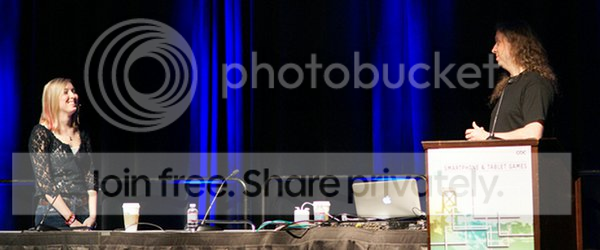


No comments:
Post a Comment